About The Story
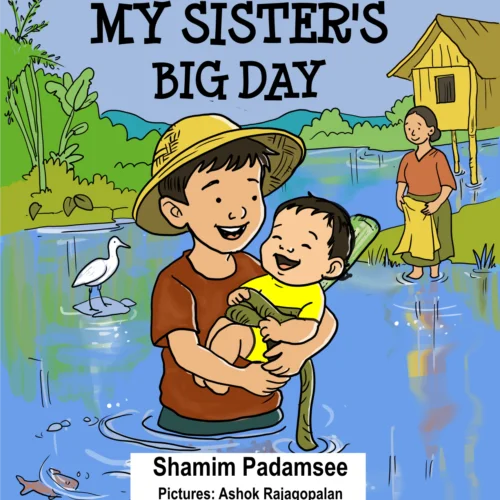
Set in the floating communities of Inle Lake, Myanmar, My Sister’s Big Day follows Maung Maung as he helps prepare for his baby sister Suu Kyi’s first swimming lesson. As he paddles across the lake, readers are introduced to daily life in this remarkable water-based world—boats gliding through lily-filled channels, floating farms, bustling markets, pagodas, monks, buffaloes, and homes built on stilts.
Maung Maung gathers vegetables from his family's floating farm, delivers fresh produce to a monk from the pagoda, and finally purchases a sturdy banana stem for his sister's special milestone. Along the way, children discover how people adapt creatively to life on the water and see how traditions and lifestyles are shaped by the environment in which they live.
At its heart, the story is a warm celebration of sibling love, family responsibility, cultural traditions, and the simple joys of childhood.
Maung Maung gathers vegetables from his family's floating farm, delivers fresh produce to a monk from the pagoda, and finally purchases a sturdy banana stem for his sister's special milestone. Along the way, children discover how people adapt creatively to life on the water and see how traditions and lifestyles are shaped by the environment in which they live.
At its heart, the story is a warm celebration of sibling love, family responsibility, cultural traditions, and the simple joys of childhood.
Themes
Culture & Tradition
Family & Friends
Community
Sub Themes
Floating villages and water-based lifestyles
Sibling care and responsibility
Childhood milestones
Nature and waterways
Parent-Teacher Guide
Learning Outcome
- Understand how geography and the natural environment influence the way people live, work, and travel.
- Explore how communities adapt creatively to the unique conditions of their surroundings.
- Recognize that sibling love, care, and concern are universal values shared by families around the world.
- Appreciate the important role children can play in helping and contributing to family life.
- Develop respect and curiosity for cultures, traditions, and ways of life that may be different from their own.
Lesson Plan
- People adapt their lifestyles to the environment in which they live.
- Children can make meaningful contributions to their families and communities.
- Family love, care, and responsibility are shared values across cultures.
Activities
- Activity 1: Floating or Sinking? (Science)
- Materials: Bowl of water, Banana stem (if available),Cork, Wood, Plastic toy, Stone, Leaf
- Investigation: Children predict which objects will float and which will sink. Record findings.
- Activity 2: Helping Hands Chart
- Recognize children’s contributions to family life.
- Create a class chart: “Ways We Help at Home” Each child contributes one idea for the chart
- Activity 3: Family Care Hearts
- Each child takes a paper heart and writes names of:
- People who care for them, And those whom they care for.
- Activity 4: Community Connections Around the World
- Find out about other communities that live on water
- Explore other communities shaped by geography.
- Activity 5: Caring for Waterways
- If you were living on a water-body what would you do to protect its health and yours, too?
- How can we care for rivers, lakes, and oceans?
Story Discussion Guide
Before reading
- How do you help at home?
- Have you ever cared for a younger sibling, cousin, or friend?
- What would life be like if your house stood above water?
- How would you travel to school, the market, or a place of worship if there were no roads?

During reading
- Ways people travel.
- How food is grown.
- How people help one another.
- Things that are different from their own community.
- Things that are surprisingly similar.

After reading
- Geography: Why do people use boats instead of bicycles or cars?
- What makes the farms float?
- What challenges might people face living on a lake?
- Family: How does Maung Maung show he cares for Suu Kyi?
- Why is helping family important?
- Culture: What traditions did you notice?
- Why do families pass traditions from one generation to the next?

Applicable Sustainable Development Goals
SDG 4 – Quality Education
The story highlights learning through lived experiences, observation, and traditional knowledge passed between generations.
SDG 11 – Sustainable Cities and Communities
Children discover how floating communities adapt sustainably to life on water.
SDG 14 – Life Below Water
The story gently introduces children to freshwater ecosystems and respectful coexistence with waterways.
Sign up to receive notifications whenever we
release new books
Post Views: 46